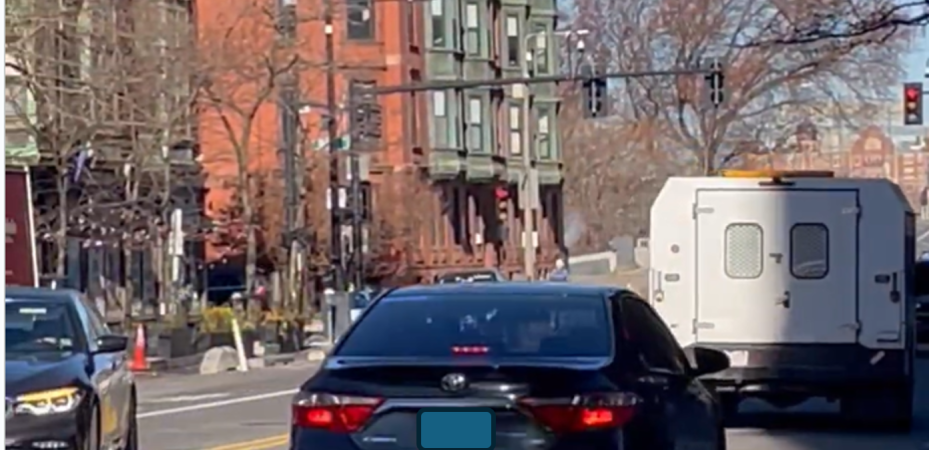
On my commute through Boston last week, I watched three cars blow through a red light at different busy intersections—not yellow, but solid red. None slowed down. No police in sight. Just another Tuesday in Boston.
This isn’t just anecdotal frustration. The data tells a troubling story about declining traffic enforcement and rising safety concerns on our streets. Fortunately, there’s a solution waiting in the wings.
A Critical Bill Awaits Action
Massachusetts cities and towns may soon gain the ability to deploy automated traffic enforcement cameras for red-light running, speeding, and other violations. Bill S.2344, An Act relative to traffic regulation using road safety cameras, was approved by the State Transportation Committee in July 2025 and now awaits a hearing with the MA Senate Ways and Means Committee.
This law cannot be passed soon enough.
Crashes are Up in Boston
The consequences of red light running are severe. According to the Insurance Institute for Highway Safety (IIHS), over 1,000 people were killed in crashes involving red light running in 2023 across the United States, with 134,000 injured.
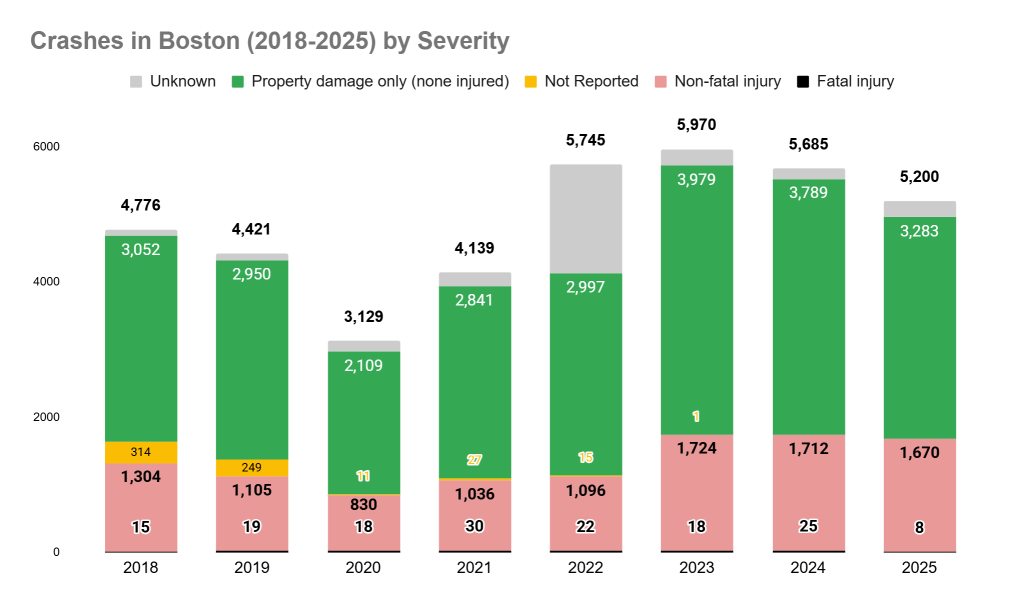
In Boston, crash data tied to red light violations are not easily obtainable, but total crash statistics and severity data are now well tracked through MassDOT’s Crash Data Portal. Crash numbers post-pandemic (‘22 – ‘25) are about 23% higher, on average, compared to pre-pandemic years (about 1,000 more crashes in Boston). Injuries are about 14% higher when comparing injuries from the last three years (‘23-’25) to 2018 and 2019 (including the crash incidents where injuries were “not reported”). Fortunately, crashes involving fatalities are down so far this year (8 as of mid-December 2025 compared to 19 in 2019 and 25 in 2024).
Enforcement Has Dropped
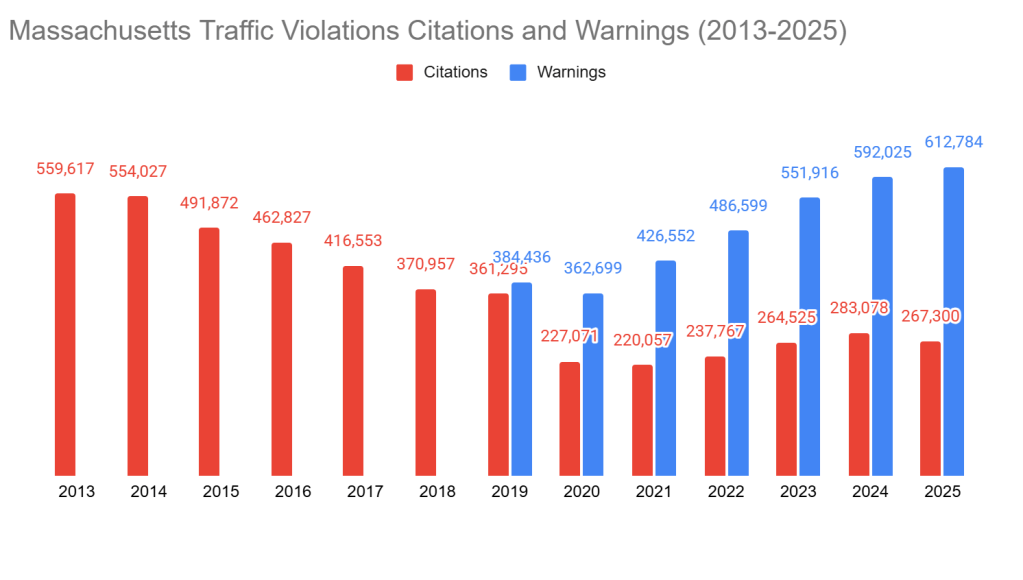
Traffic citations in Massachusetts have plummeted over the past decade. According to data from MassDOT’s Citation Data Portal, overall citations have dropped by nearly 50% over the last ten years. While warnings have increased, they carry none of the monetary or legal weight needed to change behavior.
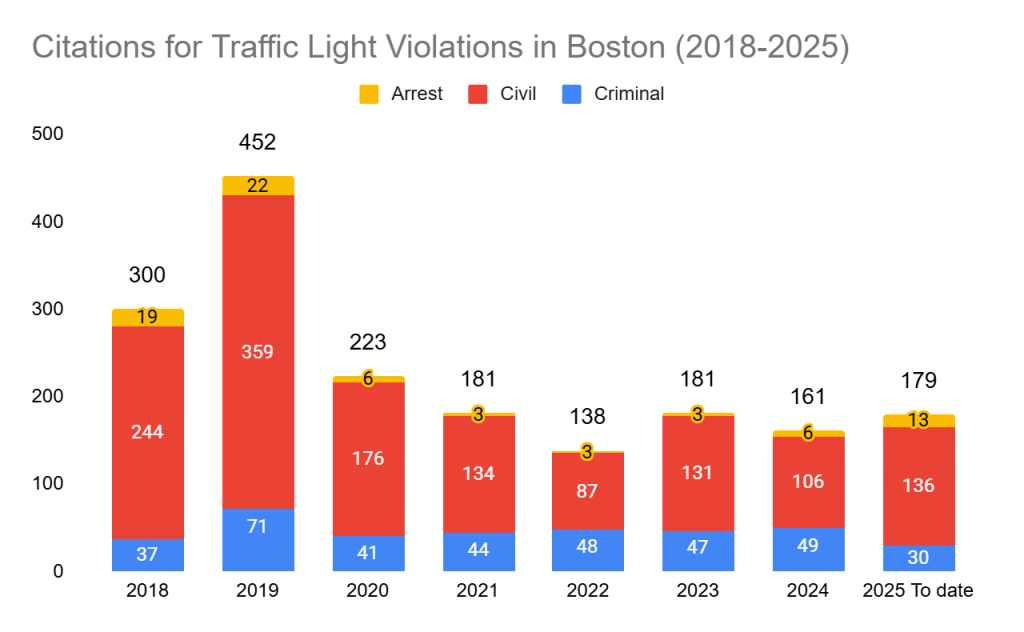
The decline is just as dramatic for traffic light citations in Boston; these fell 40% from 2018 to 2025 and 60% from 2019 to 2025.
Why Are Drivers Running Red Lights?
Several factors may be contributing to this dangerous trend:
The delivery economy: The pandemic surge in delivery vehicles—cars, mopeds, and e-motorcycles—has created a permanent fleet of drivers incentivized to move fast with little risk of enforcement. Getting to the next destination quickly means more money.
Modeling bad behavior: When cyclists, mopeds and e-bike riders routinely run red lights, some car drivers may feel emboldened to do the same. However, there’s a critical difference: a car speeding through an intersection after the light turns red poses far greater danger to vulnerable road users than a cyclist proceeding cautiously at 10 mph.
Lack of consequences: With enforcement down dramatically, drivers have learned that red lights are increasingly optional.
Massachusetts Is an Outlier on Camera Laws
For a state with a long-standing reputation for aggressive drivers (affectionately termed “Massholes”), it’s surprising that Massachusetts has no state law or local ordinance either permitting or banning traffic cameras. According to the Insurance Institute for Highway Safety (IIHS), Massachusetts and New Jersey are the only top-ten most densely populated U.S. states without any red-light camera legislation (see the IIHS web page dedicated to red light running here).
Meanwhile, several of the largest U.S. cities have successfully implemented red light camera programs, including New York City, Washington D.C., Chicago, and Philadelphia. Boston won’t need to reinvent the wheel.
What Boston Residents Want
Community sentiment strongly supports increased enforcement. From neighborhood conversations to social media discussions, Bostonians are fed up with dangerous street conditions and want action. The message is clear: a red light must mean stop. If we don’t address this now, today’s bad behavior will only spread.
A Solid Starter Solution, but Not the Only One
The proliferation of vehicle types on our streets—traditional cars, delivery vans, e-bikes, mopeds, and scooters—combined with declining enforcement and drivers’ lax adherence to traffic rules, has created chaos. We need solutions that provide consistent, fair enforcement without requiring massive increases in police traffic stops. Automated enforcement cameras are an important and critical tool, but not the only one needed to restore order to our streets. We also need improved enforcement of traffic rules for class 3 micromobility riders (mopeds and e-bikes that exceed 25 mph), as well as sensible road rules for different types of users (e.g., manual bike vs. moped riders) coupled with education (or re-education). I’d also love to see public health and communications students from our many university campuses collaborating to create catchy messaging that makes breaking road rules socially inappropriate and unappealing.
Data sources: MassDOT Citation Data Portal, MassDOT Crash Data Portal, Insurance Institute for Highway Safety. Charts and analysis by Happy Commutes.
 Happy Commutes